Progressives for AI
AI reached 700,000 clinicians a month
Issue 32 · 20 October 2026
Quick Take · News · Put AI to Work · Looking Ahead
In this issue
- 🩺 By June, about 700,000 doctors, physician assistants and nurse practitioners used one AI tool every month. The next step is proving it helps patients.
- 🔢 81% of businesses in one Federal Reserve survey used AI. Only 2% of those using it said AI cut their staffing.
- 💻 Free AI models you can download and run yourself had a big week.
- 💰 Anthropic plans to put 5% of its shares into a fund for the public good.
- 🛠️ Put AI to Work: run a free AI model on your own computer, so private notes stay private.
🔎 Quick Take
A new study in JAMA found that by June 2026, about 700,000 doctors, physician assistants and nurse practitioners used one AI tool every month. In January 2024, that number was 355.
That is fast. One of the researchers compared it to electronic health records. Their spread was slow, he said, and "only really occurred after government regulation."
The same thing is happening outside the clinic. Businesses are adopting AI quickly, and free AI models you can run yourself keep getting better. AI is part of daily work now.
So the next questions are ours to push: does this help patients, and can a small nonprofit use the same tools as a big company? This week brought news on both, from a public benefit fund to open tools for tuberculosis research.
Let's get into it.
🔢 Number of the week
81%
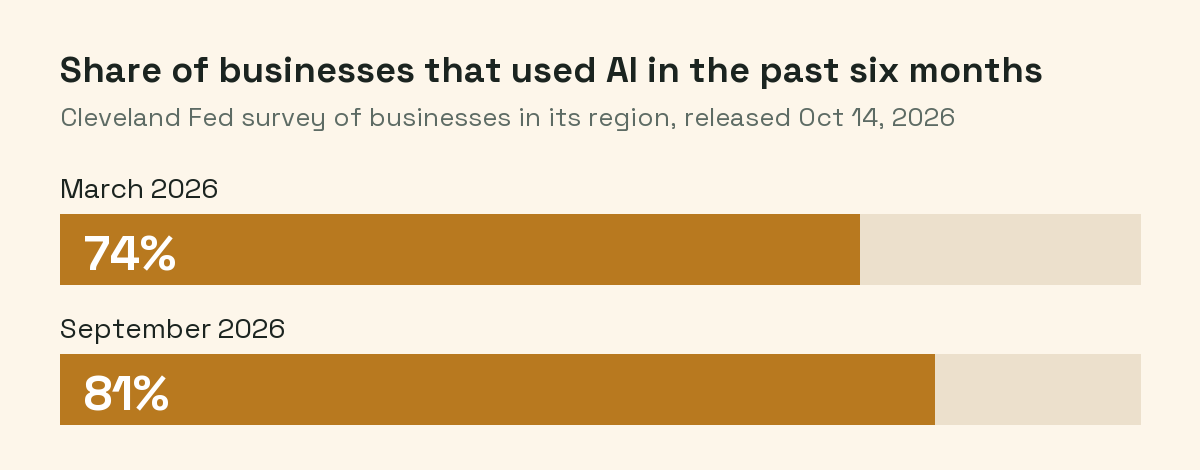
That's the share of businesses in a Cleveland Fed survey that used AI in the past six months. In March, it was 74%.
The survey also asked the 157 firms using AI about jobs. Most said AI didn't change their staffing. 11% said AI increased their staffing, and 2% said it decreased it.
This is one survey of 193 businesses in Ohio and nearby states, so it isn't the whole country. Still, among firms using AI in this region, more said it added jobs than said it cut them.
📰 AI News Roundup
🩺 Lead: AI is already part of medical care
What happened: Researchers at Harvard Medical School and Brigham and Women's Hospital studied how clinicians use OpenEvidence, an AI tool that answers medical questions. The study looked at about 950,000 U.S. doctors, physician assistants and nurse practitioners over two and a half years. JAMA published it on October 15.
Monthly users grew from 355 in January 2024 to 703,265 in June 2026. Together they asked 270 million questions. About half were about clinical decisions, mostly treatment. Many questions were about topics outside the clinician's own specialty.
"An enormous number of physicians are using AI for clinical care," said Anupam Jena of Harvard Medical School, the study's corresponding author. They are "often using it in areas where they don't have specific expertise."
The National Institutes of Health funded the study. OpenEvidence provided the data but did not pay for the research. Three of the co-authors work or worked for the company.
Why this matters: Clinicians decided this tool was useful, and they adopted it quickly. That is a good sign for patients who need a fast, informed answer. The study didn't measure patient outcomes. The researchers say that is the next step. That research needs public funding, and its results need to be public.
What you can do
If you work in health care advocacy, ask your state health department or your hospital system two questions. Which AI tools do our clinicians use? And who is studying whether they improve care? Source: Harvard Medical School, October 15, 2026
💻 Free AI models you can run yourself had a big week
What happened: Three companies released "open-weight" AI models. You can download these models and run them on your own hardware. The test results below come from the companies themselves.
- DeepSeek released a model under the MIT license, so anyone can use it, even to build a paid service. On one coding test, DeepSeek says it scored 77, compared with 74 for Anthropic's Claude Opus 5. Opus 5 still won on two other tests.
- Nvidia released models built to run on new PCs with Nvidia's own chips. People "can delegate everyday projects … without sending those workloads to the cloud," wrote Nvidia's Kari Briski.
- Meta released Muse Spark Open, which it calls the "most capable" open-weight model in the U.S. It is very large. Running it at home needs at least 1 terabyte of memory, so most people will use it through online services.
Why this matters: When good models are free to download, more organizations can afford them, and more can keep their data at home. That matters for groups that handle sensitive information, like legal aid clinics, immigrant rights groups and health centers. It also means a few companies don't control all the best tools.
What you can do
Try a smaller open model on your own computer. This issue's Put AI to Work section shows you how. Sources: The Neuron, October 19, 2026; TechCrunch, October 19, 2026; TechCrunch, October 15, 2026
💰 Anthropic plans to put 5% of its shares into a fund for the public good
What happened: On October 18, Anthropic said it will commit 5% of its shares to a "public benefit fund," subject to stockholder approval. The fund will be a wholly owned entity inside the company. The board may add 2% more for every 50% increase in the company's value above a set baseline.
Anthropic gave a few early ideas for the money, such as "large donations to traditional nonprofits or direct distributions to specific populations." It has also committed $200 million to study AI's effect on jobs. Anthropic says it will share how the fund will be run "in the coming months."
Why this matters: If AI creates a lot of wealth, some of that wealth should go back to the public. A fund like this is one way to do it. The details decide how much good it does. Who picks the projects? How open is the process? Do the communities affected by AI get a voice?
What you can do
If your organization works on economic justice or workforce issues, watch for the governance details. When Anthropic publishes them, tell the company what a fair process looks like. Source: TechCrunch, October 18, 2026
🗳️ Briefly: Georgia launches a chatbot for state information
Georgia's Secretary of State launched GABBY on October 8. It answers residents' questions using information published on the office's website. Secretary of State Brad Raffensperger said residents "shouldn't have to spend their time searching through a government website or waiting on the phone to get a simple question answered."
Source: StateScoop, October 9, 2026
🏆 Progressive AI win
Open AI tools for tuberculosis research
The Gates Foundation gave a grant to DaltonTx, a London start-up, to search for new tuberculosis treatments with AI. The company's tool will screen huge numbers of possible chemicals by computer to find promising starting points for new drugs.
DaltonTx is working with Ersilia, a nonprofit, and together they plan to make the project's models, workflows and data "open-access." The goal is to help lower-resource labs "across the Global South," the company said.
If the release happens as planned, labs with small budgets will be able to use the same models and data as the project.
🛠️ Put AI to Work
Practical ways progressives can use AI this week
Run a free AI model on your own computer
Some work is too private to paste into a cloud chatbot: donor notes, client case details, internal staff issues. A local AI model runs entirely on your computer. A free app called LM Studio makes it easy to try.
Check your computer first. On a Mac, you need an Apple Silicon chip (M1 or newer) and macOS 14 or later. LM Studio recommends 16 GB of memory. On Windows, most computers need a processor that supports AVX2. LM Studio also recommends 16 GB of memory and a graphics card with at least 4 GB of its own memory.
Get started:
- Download LM Studio from lmstudio.ai.
- Inside the app, download a small model. Smaller models download faster and run better on ordinary laptops.
- Pick the model you downloaded, then type into the chat window. For private work, skip the app's optional cloud models and web search, so everything stays on your computer.
Three ways to use it this week:
- Summarize sensitive meeting notes. Paste in notes from a staff or client meeting and ask for decisions and next steps.
- Draft donor thank-you notes. Give it names and gift details that you'd rather keep off a company's servers.
- Work without internet. It runs on a plane, at a rural event, or anywhere the Wi-Fi is bad.
Two cautions. Small models can get things wrong, so check facts, numbers and names. And check your organization's tech policy before you install new software. LM Studio's terms allow internal work use, but some features cost money.
Source: LM Studio system requirements
From our friends
Your org deserves its own AI. Not Big Tech's.
Change Agent is a private AI platform built for nonprofits, unions, and advocacy orgs. Your data stays yours, it plugs into tools you already use (Google Drive, Slack, ActBlue), and it handles the tedious stuff so your team can focus on the mission. Starts at $35/month. Small nonprofits under $1M can apply for discounted pricing.
Learn more🔭 Looking Ahead
Patient outcomes. The JAMA researchers say their next question is whether AI tools improve care. Watch for that study, and for who pays for it.
Agents that negotiate for you. Anthropic is asking lawyers how AI agents should negotiate for their users, according to The Neuron, citing the Financial Times. No product has been announced. (The Neuron, October 19)
October 26: Colorado's hearing and comment deadline on its AI decision rules. Comment at coag.gov/ai.
Something to think about: Steve Newman wrote about seven Anthropic engineers who rebuilt the company's core code tools in five months. Claude wrote most of the code. His point is that AI doesn't have to be smarter than experts to change what's possible. "It just needs to be superhumanly fast and cheap." Think about what that could mean for small organizations that could never afford custom software. (Second Thoughts, October 14)
Until next time,
Jordan
Read past issues · RSS · Bluesky · Website
