Progressives for AI
AI is a power tool, and a person runs it
Issue 31 · 13 October 2026
Quick Take · News · Put AI to Work · Looking Ahead
In this issue
- 🔧 Vermont and Utah, one blue-leaning and one red, take the same approach to government AI: a tool that a trained person operates.
- 🔢 79% of Americans who skip AI chatbots say privacy is a reason. That's a to-do list for the people building them.
- 🏭 New Jersey's Fair Act would require 60 days' notice before AI changes your job.
- 🗳️ Colorado takes public comments on its AI decision rules until October 26. You can weigh in.
- 🛠️ Put AI to Work: talk your first draft out loud, then edit it.
🔎 Quick Take
A Vermont official has a good way to describe AI at work: it's a power tool, and a human runs it.
Two states are putting that idea into practice. Vermont is training its own staff to use AI on real government work. Utah's Republican governor signed an order telling agencies to look for good uses of AI and to train the people who'll use it.
Neither state is waiting for Washington. And both put a person in charge of the work. That's the model progressives should push for everywhere.
Let's get into it.
🔢 Number of the week
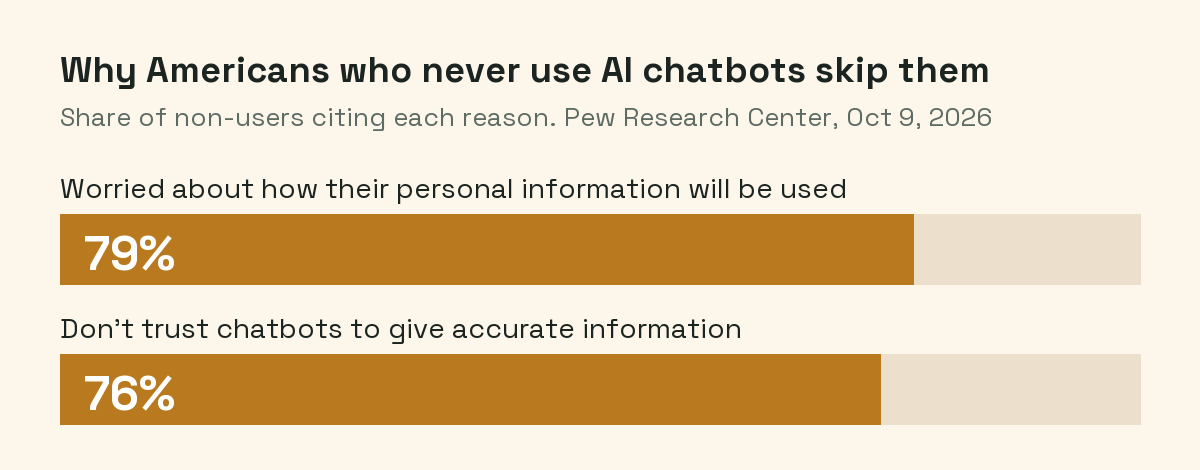
79%
That's the share of Americans who never use AI chatbots who say privacy is a reason. They're "concerned about how their personal information will be used." Another 76% don't trust chatbots to give accurate answers.
Pew found that 51% of U.S. adults never use a chatbot. Among people 65 and older, it's 77%.
Most of them don't plan to start soon. Still, two of their most common reasons are problems we can work on: protecting people's data and getting the facts right. Lawmakers can write rules for both.
📰 AI News Roundup
🔧 Lead: two states, one rule for AI in government
Vermont. Josiah Raiche, the state's chief data and AI officer, calls AI a power tool. A power tool "is operated by a human, there's a human operator," he told StateScoop.
According to Raiche, Vermont runs about 1,100 software applications, some of them decades old. About 100 state developers have finished AI training, with 50 more on the way. They've already patched several dozen of those apps. Each agency also picks trusted staff as "pathfinders." They get about a three-month head start, then help train their teams.
Raiche's best example came from the Secretary of State's office. Staff had to check hundreds of ballots against a list of about 3,000 candidates, days before printing. They built an AI tool to flag likely errors, then checked every ballot by hand. The whole job took three hours. "I got there at 9 in the morning, and we got it done by noon," Raiche said.
Vermont has been at this a while. It set up the first state AI task force in 2018, and that task force recommended a state AI code of ethics in 2020.
Utah. On October 6, Governor Spencer Cox signed Executive Order 2026-08 for what Utah calls "Pro-Human AI." Agencies must look for ways AI can improve their work and be open with the public about it. Affected state workers get AI training, and decisions that affect people's rights get human review. The state must also guard against cyberattacks and rogue AI agents. The first progress report is due July 1, 2027.
"The choice between innovation and safety in government is a false one," Cox said. Technology "must always remain accountable to the people."
Why this matters: Public agencies make decisions that shape people's lives: benefits, ballots, licenses. Vermont shows how this works in practice, and Utah is writing it into policy. Train the workers, keep a person responsible for decisions about people, and tell the public.
What you can do
Ask your state's chief information officer, or your state legislator, two questions. Who trains state workers to use AI? And who checks the AI's work before it reaches the public? Sources: StateScoop, October 2, 2026, GovTech, October 7, 2026
🏭 New Jersey's Fair Act moves forward
What happened: New Jersey's Senate Labor Committee unanimously approved the Fair Act (S4075). This is a different bill from the rent-algorithm law we covered in Issue 24.
Employers would have to give 60 days' notice before using AI that significantly changes people's jobs. If AI eliminates jobs, employers must offer training, extended severance and benefits. The bill also limits productivity monitoring and sets rules for AI in hiring and firing. AI can't undermine "an employee's autonomy, dignity, or welfare."
"It makes sure employers can't spy on you when you are off the clock," said Charles Wowkanech, president of the New Jersey State AFL-CIO. Business groups say the rules are vague and hard on small employers. Next, the bill goes to the Senate Budget Committee, then the full Senate.
Why this matters: The bill lets employers adopt AI. It asks them to warn workers first and to help the people whose jobs change.
Source: Philadelphia Inquirer, October 7, 2026
🗳️ Colorado wants your comments on its AI decision rules
What happened: Colorado's new AI law takes effect January 1, 2027. It covers AI that helps make big decisions about jobs, housing, loans, insurance, health care, school and government services. People must be told when AI is used. After a bad outcome, they get an explanation and the right to correct their data and ask for a human review.
The attorney general is writing the rules now. The draft says the human reviewer must be trained and have real power to change the decision. A public hearing is on October 26 in Denver, with a remote option. Written comments are due the same day.
Why this matters: This is where "a human checks it" gets defined in practice. Industry groups have already filed comments. The people these decisions affect should file too.
What you can do
Comment before 11:59 p.m. Mountain Time on October 26 at coag.gov/ai. Two sentences about how an AI decision affected you or the people you serve is enough. Source: Colorado Attorney General
🏆 Progressive AI win
A wage-theft chatbot built with legal aid gets $5M to grow
Scale Justice won $5 million in the Aspen Institute's Workplace Innovation Now Challenge. The prize goes to Reclamo.AI, a chatbot built with the New York Legal Assistance Group.
It answers questions about wage theft, underpayment and harassment, in English and Spanish. Its answers come from legal aid material, and it explains how to reach an attorney. Developer Rodrigo Camarena says more than 5,000 people used it in the past year.
The money will pay for more staff and outreach to workers in retail and food service. Next, the tool will help workers gather evidence, file wage claims and organize their coworkers.
"This funding is going to allow us to radically and dramatically expand the impact that we've had to date," Camarena said. Legal aid lawyers helped build it, and it points workers to real attorneys. I want to see a lot more AI built this way.
🛠️ Put AI to Work
Practical ways progressives can use AI this week
Talk your first draft, then edit it
Stuck on an action alert, a donor email or your talking points? Say it out loud first. "When I'm stuck, I dictate rather than battle my inner critic," writes Jeremy Caplan of Wonder Tools.
Free tools work fine:
- Google Docs voice typing (Tools menu, in Chrome). Over 100 languages.
- Voice Memos or Notes on an iPhone, which transcribe for free.
- Google Keep on Android.
- Lispr on a Mac.
Talk for two minutes without stopping. Then paste the transcript into your AI tool and ask it to tighten the draft without changing your words. You'll edit something real instead of staring at a blank page.
One caution: many dictation tools process your voice in the cloud. Keep donor names and client case details out of it, and check the tool's privacy policy first.
Source: Wonder Tools, October 9, 2026
From our friends
Your org deserves its own AI. Not Big Tech's.
Change Agent is a private AI platform built for nonprofits, unions, and advocacy orgs. Your data stays yours, it plugs into tools you already use (Google Drive, Slack, ActBlue), and it handles the tedious stuff so your team can focus on the mission. Starts at $35/month. Small nonprofits under $1M can apply for discounted pricing.
Learn more🔭 Looking Ahead
October 26: Colorado's hearing and comment deadline on its AI decision rules. We've flagged this in the last two issues. This is the last call.
Google's new AI work agents come with audit trails, spending caps and other controls built in, according to Google's announcement as reported by The Neuron. The announcement didn't include a full rollout schedule or pricing. Controls like these should be standard, so watch which companies follow. (The Neuron, October 8)
Senator Warner's AI AGENT Act (S. 5051) hasn't moved since it was sent to committee in July. His feedback form is still open.
Until next time,
Jordan
Read past issues · RSS · Bluesky · Website
