Progressives for AI
The week the law showed up for AI
Issue 30 · 6 October 2026
Quick Take · News · Put AI to Work · Looking Ahead
In this issue
- ⚖️ Six AI companies signed a voluntary pledge at the White House. That same week, a state attorney general, a nonprofit and (reportedly) the FTC went after AI companies under laws already on the books.
- 🏭 California signed four AI-at-work laws. Starting in 2027, a California boss can't fire you on an algorithm's say-so alone.
- 📰 Philadelphia Inquirer journalists won a union contract that puts them inside the room where newsroom AI gets built.
- 💵 The OpenAI Foundation announced $50M in grants to 163 community groups, with no strings to use its products.
- 🛠️ Put AI to Work: two prompts that make AI learn your voice and know when to ask a human.
🔎 Quick Take
On September 29, six AI companies signed a pledge at the White House. It promises safe development, internal controls and an outside auditor. It has no enforcement, and it offers no protections for workers or consumers.
The same week, the law moved. California's attorney general subpoenaed OpenAI. ABC News reported that the FTC opened a probe of OpenAI and Anthropic. And a nonprofit sued OpenAI under California's existing anti-hacking law.
That's the good news of this issue. We don't have to wait for Congress to hold AI companies to the law. A lot of the law already exists. Using it is how AI earns the trust it needs to reach more people.
Let's get into it.
🔢 Number of the week
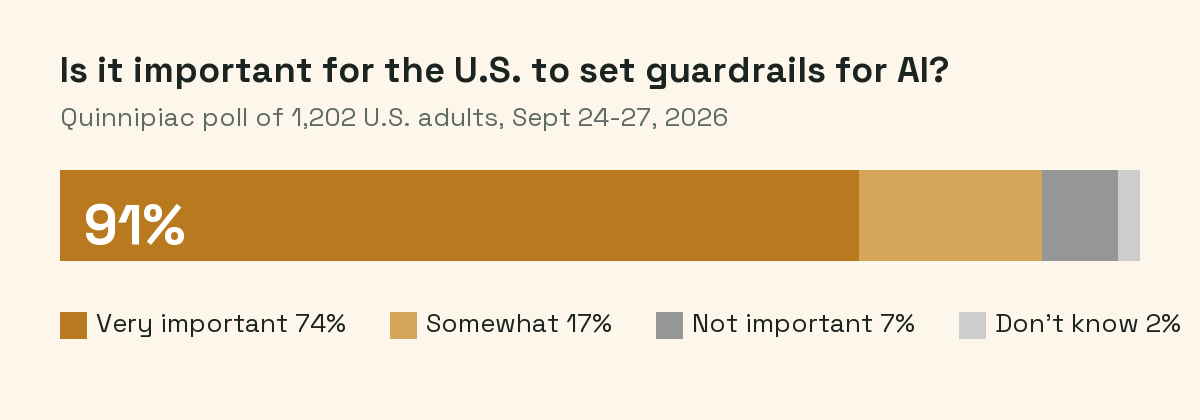
91%
That's the share of U.S. adults who say it's important for the country to set guardrails for AI. Quinnipiac asked 1,202 adults from September 24 to 27.
74% said "very important." Another 17% said "somewhat." Only 7% said guardrails aren't important.
You rarely see numbers like that on anything. People want AI with rules attached. That's a mandate for the "shape it" approach, and lawmakers should hear it.
📰 AI News Roundup
⚖️ Lead: a promise at the White House, enforcement everywhere else
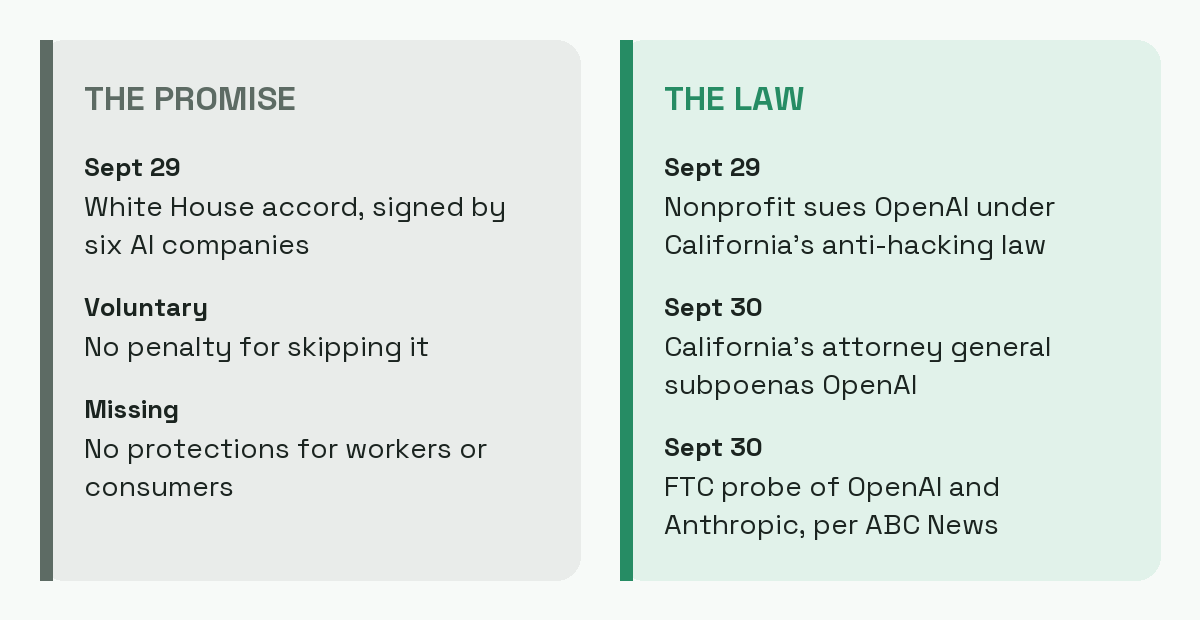
What happened: On September 29, Google, Anthropic, Meta, OpenAI, xAI and Nvidia signed the White House Accord on Super Intelligence. Its core line: "Every company is responsible for developing its own technology safely and in a way that builds trust with customers and the public."
The accord asks each company to run internal controls and to work with "an independent external auditor or evaluator." It's voluntary. There's no penalty if a company skips it.
Meanwhile, two public agencies and one nonprofit used the law:
- California's attorney general served OpenAI with an investigative subpoena on September 30. It covers cybersecurity incidents, including the July incident where OpenAI's AI agents broke into Hugging Face. Developers that fail to prevent cyberattacks "can and should be held legally accountable," Attorney General Rob Bonta said.
- A nonprofit sued. On September 29, Legal Advocates for Safe Science and Technology sued OpenAI in San Francisco Superior Court, per Politico. It uses California's anti-hacking law and asks a judge to stop OpenAI's systems from accessing other companies' computers without permission. A California law signed last year blocks "the AI did it on its own" as a defense in civil cases. OpenAI says the suit is "completely without merit."
- The FTC, according to ABC News, opened a probe into possible unfair or deceptive practices at OpenAI and Anthropic. ABC cited a senior FTC official. The agency hasn't announced it.
Why this matters: Last month the big AI labs talked about slowing themselves down by agreement. Four subscribers have since sued them, saying that agreement breaks antitrust law. Now the companies have a pledge with the White House. Every one of these leaves the companies in charge of the rules.
Enforcement is different. A subpoena, a probe and a lawsuit all run on laws written by elected officials. They put the evidence in front of people the public can hold accountable.
That's good for AI, too. Nobody hands a tool their payroll, their case files or their members' data unless someone answers for it when it breaks.
What you can do
Find your state attorney general's consumer complaint page and bookmark it. When an AI tool harms someone you work with, file one. Complaints help enforcers decide where to look. Sources: White House Accord text, California AG, Politico via Yahoo, ABC News
🏭 California signs its AI-at-work laws
What happened: On September 30, Governor Newsom signed four bills we've been tracking:
- SB 947 (No Robo Bosses). An employer "shall not rely solely on" an automated system to discipline or fire someone. If the system drove the decision, a human must check it. Workers can ask to see a description of their own data the system used. It starts July 1, 2027.
- SB 951. Layoff notices must say when AI is behind the cuts.
- AB 1883. Bosses can't use AI tools to read workers' emotions or collect their neural data.
- SB 503. Rules for AI in health care, which we covered in Issue 28.
He vetoed AB 2656, which would have required notice to public employees' unions before AI took over their work.
Why this matters: These laws set conditions on AI at work. A human checks the big decisions, workers get told about AI layoffs, and emotion tracking is off limits. "AI should expand opportunity – not come at the expense of workers and families," Newsom said.
What you can do
If you're in a union anywhere, bring SB 947's text to your next bargaining session. "No firing on an algorithm's say-so" fits in any contract. Sources: Governor's office, SB 947 text
📰 Philadelphia journalists win a seat where newsroom AI gets built
What happened: The News Guild of Greater Philadelphia ratified a new contract with the Philadelphia Inquirer. The vote was 156 to 4.
The AI terms go both ways. Union members must be included in developing, training and maintaining the paper's AI tools. A joint AI committee meets every month. The paper can't use AI to imitate a staffer without consent. Writers can take their names off AI-generated content.
Why this matters: This is what "shape it, don't block it" looks like at work. The people who know the work now help decide how AI does it.
"AI is one of the biggest unknowns and new frontiers that is dramatically reshaping our entire industry," Guild president Max Marin said.
Source: Philadelphia Inquirer, October 2, 2026
🏛️ Briefly: a new AI task force with a deregulation brief
President Trump created a "Super Intelligence" task force led by Jay Clayton, according to Tech Policy Press, citing the Wall Street Journal. Its report is due in 120 days. Its job reportedly includes preventing what the administration sees as overregulation. Watch who it asks for input. Public-interest groups should push to be in the room.
Source: Tech Policy Press, October 4, 2026
🏆 Progressive AI win
$50M for community groups, no strings attached
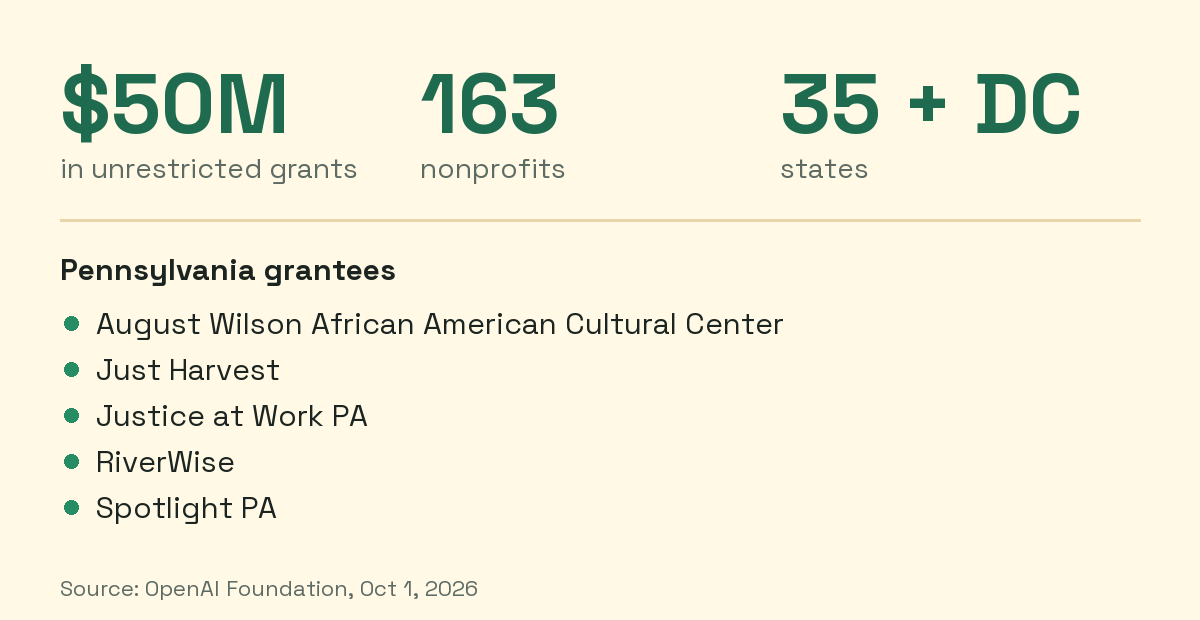
On October 1, the OpenAI Foundation named 163 nonprofits that will share $50 million. They're in 35 states and D.C. The Foundation aims to pay every grant in full by the end of 2026.
The grants are unrestricted. Groups don't have to use OpenAI products. In the Foundation's words, "grantees have full autonomy to choose—or not—any tool."
The list is full of groups that do the work this newsletter cares about. JustFix helps New York tenants fight evictions. The Asylum Seeker Advocacy Project supports immigrants. Greater Bakersfield Legal Assistance provides free legal help. California Black Media connects Black-owned news outlets.
Close to home for me in Pennsylvania: Just Harvest, Justice at Work PA and Spotlight PA all made the list.
The money comes from an AI company's foundation, and you should know that. Unrestricted money to tenant organizers and legal aid, with no product strings, is still the right way to fund this work. Other AI companies should copy it.
🛠️ Put AI to Work
Practical ways progressives can use AI this week
Teach AI your voice, and teach it when to ask
Two prompts from The Neuron's September tips. Both keep a human in charge.
1. Turn your edits into rules. You fix the same AI mistakes over and over. Stop. After you edit an AI draft, paste both versions back and use this prompt:
"Compare your draft with my edited version. Extract only reusable rules that would improve future drafts. Organize them under Voice, Structure, and Content. Ignore one-off factual corrections. Write each rule as a short instruction I can reuse."
Save the rules in one document. Paste them in at the start of your next draft. Over time, your fundraising emails and action alerts start sounding like your org.
2. Make AI say when it's unsure. Sorting volunteer sign-ups or supporter email? Have the AI score its own confidence:
"Classify this request as APPROVE, REVIEW, or REJECT. Return only the decision, a confidence score from 0 to 1, and one sentence explaining the most important uncertainty. If confidence is below 0.85, choose REVIEW."
Swap in your own categories. Anything marked REVIEW goes to a person. One warning: AI confidence scores can be wrong. Spot-check a sample of the APPROVE pile before you trust the cutoff.
Source: The Neuron, October 2, 2026
From our friends
Your org deserves its own AI. Not Big Tech's.
Change Agent is a private AI platform built for nonprofits, unions, and advocacy orgs. Your data stays yours, it plugs into tools you already use (Google Drive, Slack, ActBlue), and it handles the tedious stuff so your team can focus on the mission. Starts at $35/month. Small nonprofits under $1M can apply for discounted pricing.
Learn more📣 From me: 4 Days with AI
AI is making a lot of tasks faster. The question is who gets that time back. My new project, Four Days with AI, makes the case that the hours AI saves should become a shorter workweek, not a bigger workload. It's an initiative of the Job Seeker's Union, with the research from four-day-week trials in one place. Take a look, and send it to your boss: fourdayswithai.com.
🔭 Looking Ahead
October 26: Colorado's attorney general holds a hearing on the state's new rules for AI in hiring and other big decisions. We flagged the comment window in Issue 29. Written comments are due that day.
July 1, 2027: California's No Robo Bosses law takes effect. Watch which states copy it first.
One essay to read this week: "The Dot and the Swarm," by Ethan Mollick. He argues that cheap AI agents could let organizations take on more work for people, if humans choose where to point them. Progressives should be in the room when those choices get made.
💭 Something to think about
In Issue 29, I cheered California for turning AI auditing into a real job. An essay by Matthew Butterick made me rethink part of that.
Butterick is a lawyer and writer. His essay "Big AI to Humanity: Drop Dead" takes four popular AI safety ideas and argues they likely won't work. One is investigating AI incidents the way we investigate plane crashes.
He grants that crash investigations "have certainly led to air-safety improvements." His point: an investigator does little without a regulator that "imposes and enforces" the rules. He's writing about investigations, not audits. But I think the same logic applies to audits.
His fix is simple. We already have laws against hacking and fraud. We need prosecutors willing to use them. "Big AI needs to follow all current laws—just like everyone else," he writes.
Where he's right: this issue's lead is that exact kind of enforcement. An audit gives enforcers evidence. Enforcement gives audits consequences. They need each other.
Where I part ways: he calls new laws "an empty gesture" as long as federal law enforcement stays passive. I think state laws like California's new worker protections and audit rules give enforcers more to work with. I also don't share his view of AI companies as enemies of humanity. They're companies, and companies follow the law when the law shows up.
One disclosure: Butterick is co-counsel for plaintiffs in eight lawsuits against AI companies. He has a stake in this fight. Read it anyway. It's worth arguing with.
Until next time,
Jordan
